


 Sales Support: Walton-on-Thames: 01932 221608 Weybridge: 01932 852765
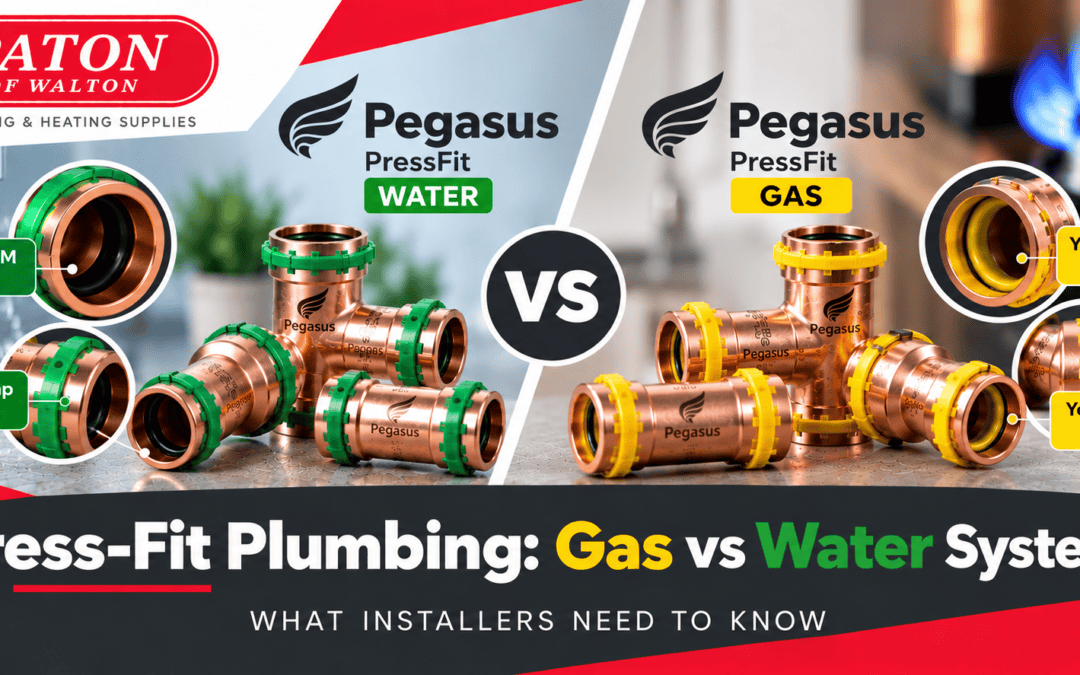
Press-fit plumbing fittings have become an increasingly familiar part of modern plumbing and heating installations, providing a quick, clean and flame-free way of joining copper pipe.
However, while water and gas press fittings can look very similar, they are not simply interchangeable versions of the same fitting.
Different applications require the correct fittings, seals and approvals, and installers need to make sure that every component being used is suitable for the system being installed.
Paton of Walton supplies Pegasus PressFit Water and Pegasus PressFit GAS, giving installers dedicated options for plumbing, heating and gas applications.
So what is the difference between them, how can you tell them apart, and what should installers check before making a press connection?
How does press-fit plumbing work?
Press-fit systems create a permanent mechanical joint between a fitting and compatible pipe.
The prepared pipe is inserted into the fitting, and a suitable press tool and jaw are positioned around it. The tool then compresses the fitting to create the joint.
With Pegasus, the fittings use an M-Profile pressing system and, when used with suitable copper tube to BS EN 1057 Table X, provide a flame-free permanent joint. Unlike soldering, there is no requirement for a naked flame, solder or flux at the joint.
This can make press-fit particularly useful when working in occupied properties, refurbishment projects and other locations where reducing hot works is beneficial.
What is Pegasus PressFit Water?
The Pegasus PressFit Water range is designed primarily for plumbing and heating applications.
According to Embrass Peerless, applications for the water range include:
- Potable water
- Heating
- Rainwater
- Sanitary water
- Compressed air
- Fire-extinguishing systems
The water range is WRAS approved and uses a black EPDM O-ring within the fitting.
It therefore provides installers with a press-fit option for many of the copper pipework applications encountered during everyday plumbing and heating work.
What is Pegasus PressFit GAS?
Pegasus PressFit GAS is the dedicated range for natural gas and LPG installations.
Like the water range, it uses M-Profile press technology and is designed to create a permanent flame-free connection when installed with the specified copper tube and correct equipment.
The important difference is that the gas fittings incorporate yellow HNBR O-rings and are DVGW approved for their intended gas applications.
This is why an installer should never select a press fitting simply because its dimensions and appearance seem suitable.
The fitting must be approved for the service it is actually being used for.
Pegasus Gas Press vs Water Press: what’s the difference?
Although both belong to the Pegasus PressFit family and use M-Profile technology, there are important differences.
| Feature | Pegasus PressFit Water | Pegasus PressFit GAS |
| Main application | Plumbing & heating | Natural gas & LPG |
| Press profile | M-Profile | M-Profile |
| O-ring | Black EPDM | Yellow HNBR |
| Crimp indicator | Green | Yellow |
| Approval | WRAS | DVGW |
| Installation | Flame-free press joint | Flame-free press joint |
| Copper tube | Suitable BS EN 1057 Table X tube | Suitable BS EN 1057 Table X tube |
Embrass Peerless also identifies its Pegasus GAS fittings with gas-specific product markings, helping distinguish them from the water range.
The key point
Use the fitting designed and approved for the application.
A standard water fitting should not be substituted for a gas fitting simply because both use an M-Profile jaw and connect to copper tube.
Why are the O-rings different?
The sealing element inside a press fitting is a critical part of the system.
Pegasus water fittings use EPDM O-rings, while the dedicated gas fittings use HNBR O-rings.
These materials are selected for different service conditions.
For the installer, there is a simple practical rule: don’t swap seals or assume that one type of press fitting can be converted into another by changing an O-ring.
The complete fitting should be used in accordance with its manufacturer’s intended application and specification.
Green for water, yellow for gas
Pegasus provides a useful visual distinction between its two ranges.
The water fittings have a green plastic crimp indicator, while the gas fittings have a yellow one.
When the fitting is pressed correctly, the coloured plastic indicator peels away from the fitting. Embrass Peerless also incorporates leak-detection features into the O-ring design.
For installers carrying both ranges, the colour difference provides a quick additional way of identifying which fitting they have selected.
However, colour should not replace checking the actual fitting, packaging and manufacturer’s markings before installation.
Can the same press tool be used for gas and water fittings?
Both Pegasus ranges use an M-Profile press, so the appropriate M-Profile equipment can be used when it meets the manufacturer’s requirements for the particular fitting size.
This can be a significant practical advantage for installers already using M-Profile press systems.
However, the same jaw profile does not mean same fitting.
The fitting itself still needs to be appropriate for water, heating or gas as applicable.
Installers should also ensure that press tools and jaws are in suitable working condition and follow the tool and fitting manufacturers’ instructions.
Why use press-fit rather than soldering?
We’ve looked at this in more detail in our guide, Pegasus PressFit vs Soldered & Compression Fittings: Which Should You Choose?
One of the main attractions is that pressing creates the connection without a naked flame.
This removes the soldering stage and can help installers work efficiently where hot works would otherwise introduce additional precautions.
Other practical benefits can include:
- Fast installation
- No solder or flux at the joint
- Consistent pressing using the correct tool
- Cleaner installation process
- Useful in restricted working areas
- A permanent connection once pressed
Press-fit still requires correct preparation and installation. Speed should never mean skipping the manufacturer’s procedure.
Preparing a press-fit joint
A reliable press-fit installation starts before the press tool is operated.
Installers should follow the manufacturer’s instructions, including requirements relating to pipe preparation, insertion and pressing.
Typical considerations include:
- Cut the pipe correctly – make a clean, square cut using an appropriate pipe cutter.
- Prepare the pipe – remove burrs or sharp edges that could damage the O-ring.
- Check the fitting – make sure it is the correct fitting for the application and that the seal is present and undamaged.
- Insert the pipe fully – follow the manufacturer’s required insertion procedure.
- Use the correct jaw profile and size – Pegasus is an M-Profile system.
- Position the jaw correctly – ensure it is located on the fitting as specified.
- Complete the press cycle – allow the tool to complete the required operation.
- Inspect and test the installation – testing and commissioning requirements will depend upon the system involved.
The fitting manufacturer’s current installation instructions should always take priority.
Gas work requires a Gas Safe registered engineer
There is an important distinction between discussing gas-rated products and carrying out gas work.
In the UK, work on gas installations and appliances must be carried out by someone who is appropriately qualified and Gas Safe registered for the work being undertaken.
Pegasus PressFit GAS provides a fitting system for professional gas installations, but using a gas-approved fitting does not itself make an installation compliant.
Correct pipe sizing, installation, tightness testing, commissioning and applicable regulations and standards still need to be followed.
Pegasus PressFit GAS sizes and fittings
The Pegasus gas range includes commonly required fitting types such as:
- Couplers
- Elbows
- Street elbows
- Tees
- Reducing teas
- Reducers
- Male and female threaded adaptors
- Stop ends
The current range includes 15mm, 22mm and 28mm options across numerous fitting types.
This makes it possible to construct many typical domestic gas pipework layouts using a dedicated press-fit system.
Pegasus PressFit Water offers a wider range of sizes
The water range covers a considerably broader selection of fitting sizes and configurations for plumbing and heating installations.
Current Pegasus water fittings extend beyond the common domestic 15mm, 22mm and 28mm sizes, with selected products available in larger sizes. For example, Embrass Peerless currently lists water press reducers and slip couplers through sizes up to 76 mm.
This makes the range suitable for a wide variety of plumbing and heating projects rather than only standard domestic pipework.
Press-fit doesn’t mean universal
Perhaps the most important message for installers is that press-fit describes the joining method, not a universal fitting standard.
Before installing any press-fit product, check:
- The intended application
- Pipe material and specification
- Fitting size
- Press profile
- Seal material
- Manufacturer approvals
- Tool and jaw compatibility
- Installation instructions
- Required testing and commissioning procedure
Two fittings may look very similar while being intended for completely different services.
Get Pegasus PressFit from Paton of Walton
Paton of Walton supplies Pegasus PressFit Water and Pegasus PressFit GAS for professional plumbing, heating and gas installations.
The Paton team can help customers find the appropriate fittings and sizes for their project.
Visit or contact the trade counters at Walton-on-Thames or Weybridge for:
- Pegasus PressFit Water fittings
- Pegasus PressFit GAS fittings
- M-Profile press tools
- Compatible jaws
- Copper tube
- Fittings and accessories
Trade accounts are welcome.
Frequently Asked Questions
Can I use a water press fitting for gas?
No. A fitting should only be used for applications for which it has been designed and approved. Pegasus has a dedicated GAS range using yellow HNBR O-rings and DVGW-approved fittings for natural gas and LPG applications.
How can I tell Pegasus water and gas press fittings apart?
The Pegasus water range uses black EPDM O-rings and green crimp indicators. The gas range uses yellow HNBR O-rings and yellow crimp indicators and has gas-specific product identification.
Are Pegasus gas and water fittings M-Profile?
Yes. Both Pegasus PressFit Water and PressFit GAS use the M-Profile pressing system.
Can I use the same M-Profile press tool for water and gas?
Both ranges use M-Profile pressing, but the tool, jaw and fitting size must meet the manufacturer’s requirements. Always check compatibility before installation.
Is Pegasus Gas Press suitable for LPG?
Yes. Embrass Peerless specifies its Pegasus PressFit GAS range for natural gas and LPG applications.
Does press-fit require solder or a blowtorch?
No. Press-fit creates a mechanical pressed joint, so the connection itself does not require solder, flux or a naked flame.
Who can install gas press fittings?
Gas work in the UK must be undertaken by an appropriately qualified Gas Safe registered engineer. The installer must also follow the applicable regulations, standards and manufacturer’s instructions.
Where can I buy Pegasus PressFit Water and Gas fittings?
Paton of Walton stocks a large range of Pegasus PressFit Water and Pegasus PressFit GAS fittings. Speak to the team at Walton-on-Thames or Weybridge for current product availability.